Poppaea Sabina
Quo VadisPoppaea Sabina, Nero’s Augusta, is a figure whose private jealousy acquires the force of imperial authority. Once drawn to Vinicius in anger and wounded vanity, she turns his preference for Lygia into an offense and makes Lygia her enemy. Her threat is not merely personal: she can use her place at court to endanger both lovers, making her one of the forces that converts desire into political peril.
Identity and Position at Court
Poppaea is presented as a powerful Augusta within Nero’s circle. At the extravagant feast Tigellinus prepared for the emperor, Nero rearranges the table, leaving Vinicius seated beside her. Poppaea asks him to fasten her loosened bracelet; he does so with trembling hands as she gives him a guarded, seemingly modest look. The moment places her influence in the intimate choreography of court life, where proximity, gesture, and imperial favor carry consequences beyond the banquet.
The narrative sets Poppaea against Acte, Nero’s former favorite. Acte had avoided public affairs and used whatever influence she possessed to ask for mercy; she remained associated with memories of a younger, more loving Nero. Poppaea, by contrast, is linked to suspicion, rivalry, and the pursuit of vengeance. That contrast helps define two very different ways a woman close to the emperor might exercise—or refuse to exercise—power.
Lygia Becomes a Rival
When Poppaea sees Lygia at the palace, she studies her appearance and fears that the young woman may outshine her. The encounter turns beauty into a political liability: Poppaea’s attention is not admiration but comparison, and the thought that she herself has grown older sharpens her alarm. The narration connects that wounded vanity to the suspicion that Nero might notice Lygia and make her a rival.
Lygia appeals to Poppaea for compassion, but Poppaea answers by promising that she will become Vinicius’s slave that very day. The threat makes clear that Lygia’s fate is being treated as an instrument in a courtly contest rather than as a matter of her own wishes. Poppaea’s intervention places her on the side of coercive power, while Acte’s earlier decision to receive Lygia had offered a measure of protection.
Desire, Refusal, and Retaliation
At Tigellinus’s feast, Poppaea’s attention to Vinicius becomes a political hazard. Petronius later explains that Nero had shown desire for Rubria, a Vestal, while Poppaea was speaking with Vinicius; he believes Poppaea may have wished to avenge herself. Petronius says he intervened because a refusal that wounded the Augusta could have brought ruin upon Vinicius, Lygia, and himself. The danger lies not only in Poppaea’s personal interest but in the court’s capacity to turn that interest into punishment.
Petronius also warns Vinicius that Poppaea had arranged for his name to remain on the list of guests despite the story that he was ill and unable to leave home. He reads this as evidence that her desire was serious rather than a passing whim. Although he urges Vinicius not to reject her favor openly, he stresses that the consequences could reach Lygia: Poppaea had seen her at the palace and might understand why Vinicius refused her. His warning presents the Augusta’s favor as a dangerous form of patronage—an offer that carries risk if declined.
Poppaea’s attraction to Vinicius is later described as momentary, arising from jealousy, anger, and wounded vanity. Yet the refusal does not simply end the episode. Vinicius’s coolness offends her, and his preference for another woman seems to her an offense that demands vengeance. She has hated Lygia since first seeing her, believing that the “northern lily” could rival or surpass her; she resolves to bring about Lygia’s ruin. Personal desire thus hardens into a continuing antagonism even after its original impulse has passed.
Power, Loss, and Narrative Role
After Lygia is arrested, Vinicius tries every means he can think of to save her. He seeks help from members of Nero’s court and offers Tigellinus his Sicilian estates and whatever else he might request, but Tigellinus refuses, apparently unwilling to offend the Augusta. The refusal shows Poppaea’s influence operating even when she is not the person directly negotiating: her standing constrains what a powerful courtier will do.
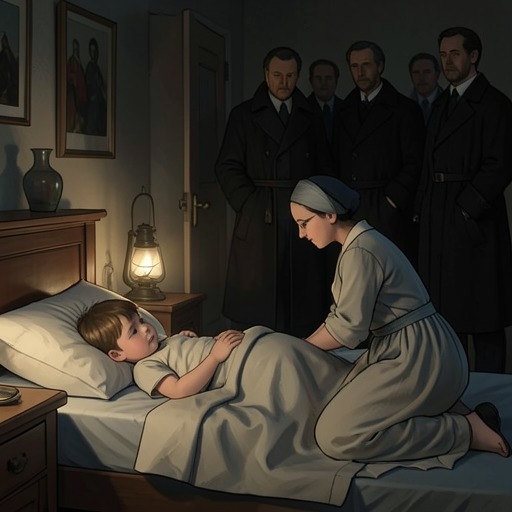
Poppaea’s own family grief enters the story through the death of the child Silvia. Petronius finds her at the bedside of little Rufius, who is gravely ill, as she fears that even saving him might only postpone a worse fate. When she returns to the Palatine and finds Silvia dead, she faints and then cries out through the night and the following day. This loss does not erase her earlier hostility toward Lygia, but it gives her courtly power a human context of fear and grief.
Poppaea’s narrative role rests on the collision between private feeling and public force. She is not shown as a simple, constant pursuer: her attraction to Vinicius is described as a passing whim, but the injury to her pride persists as hostility toward him and Lygia. Because she can shape access, favor, and danger within Nero’s court, even a brief personal affront can become a threat to other people’s freedom and safety.